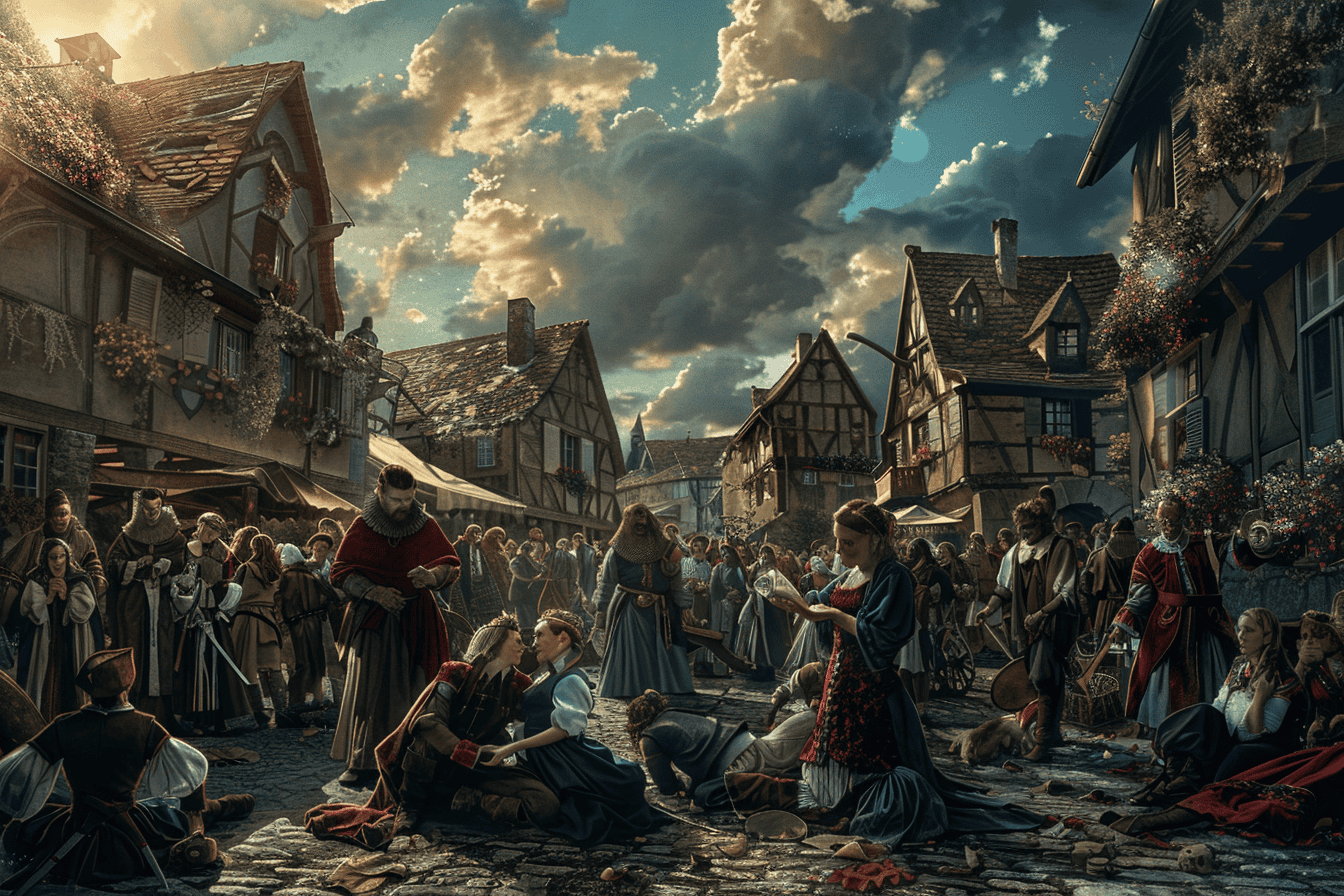
In the summer of 1518, Strasbourg was a city under strain. Part of the Holy Roman Empire, the city sat along the Rhine - prosperous in trade yet burdened by hardship. There were failed harvests, rising grain prices, outbreaks of disease and deep religious anxiety. Poverty was widespread - in fact, there was a huge divide between the rich and the poor.
Then - in July 1518, a woman stepped into the street and began to dance. Her name, preserved in later accounts, was Frau Troffea.
According to contemporary records, she continued for days, collapsing from exhaustion only to rise again and resume the motion. Her feet bled eventually, and it was said that the cobblestones of the city was marked in more ways than one.
Within a week, others joined her. At first - there was only a handful. Perhaps drawn by curiosity or fear. Then - dozens. By early August, estimates suggest that as many as 400 men and women were caught in the same relentless compulsion.
They danced in the marketplaces, in the alleyways and in front of churches and guild halls.
Physicians of the time concluded that the afflicted suffered from overheated blood―a humoral imbalance common in medieval medical theory. They urged authorities to allow the dancing to continue, until the sickness burned itself out. Eventually, stages were erected and musicians were hired. They believed that if the body was allowed to exhaust the compulsion through movement, the affliction would release its hold.
But the frenzy deepened and soon people started to die...yes...they actually died...
Reports from the period suggests that dancers died from heart failure, strokes or sheer exhaustion, though exact numbers remain debated.
Eventually, civic leaders reversed course - and music was banned. The dancers were transported to shrines, particularly those dedicated to Saint Vitus - a figure long associated with movement disorders and convulsive illness. The afflicted were fitted with red shoes and led in solemn processions in hopes that divine intervention would succeed where medicine had failed.
And, by September, the outbreak began to subside, and as mysteriously as it had begun, it ended.
Even now - historians and scientists cannot offer a single, definitive explanation. There was no identifiable pathogen. It was not the Black Death, nor a fever transmitted by insects. It spread not through cough or wound, but through proximity and observation.
Modern scholars largely interpret the outbreak as a form of mass psychogenic illness - a collective stress response that arises in communities subjected to prolonged hardship. Strasbourg in 1518 was not a peaceful or prosperous city. The region had endured years of failed harvests, rising food prices, outbreaks of disease, and recurring political tension. Many families lived on the edge of starvation. Religious life was intense and often fearful, shaped by sermons that emphasized divine punishment and moral reckoning.
In such an atmosphere of anxiety and instability, psychological strain could surface in physical form. When one individual began to move in apparent distress, others may have unconsciously mirrored the behavior, their bodies expressing fear and desperation in a shared and visible language.
Another theory points to ergot poisoning, caused by a fungus that infects rye - a staple grain in the region. Ergot contains alkaloids that can induce convulsions and hallucinations. In severe cases, it can cause gangrene or violent neurological symptoms.
While this explanation offers a biological mechanism, many historians and medical researchers remain skeptical. The effects of ergot poisoning are typically chaotic and debilitating, often leaving victims unable to sustain coordinated movement. The prolonged and rhythmic dancing recorded in Strasbourg, sometimes lasting for days and weeks, does not align neatly with the symptoms associated with ergot toxicity. As a result - the theory remains debated.
What remains clear - the event unfolded in a culture steeped in religious symbolism. The concept of “Saint Vitus’ Dance” already existed in European thought. People believed that saints could curse or cure movement disorders. The Dancing Plague of 1518 was also not entirely isolated. Similar outbreaks, sometimes called “dancing manias,” had occurred in parts of Europe before.
But Strasbourg’s episode remains the most documented and the most haunting. Because it forces an uncomfortable question - How fragile is the boundary between mind and body? In a city already weakened by hunger and fear, one woman stepped into the street and began to move. In her motion, others seemed to recognize their own unspoken distress. The dance spread from body to body, not through touch, but through shared belief, shared suffering and the fragile architecture of the human mind under strain.
More than five centuries have passed, and the records remain incomplete and the explanations uncertain. Yet the central mystery endures. We may never fully understand why they danced.
The haunting events of the Dancing Plague of 1518 is not just history to me - it is the heartbeat of my debut novel - The Devil’s Dance.
https://www.thelancet.com/article/S0140-6736(09)60386-X/fulltexthttps://www.thelancet.com/article/S0140-6736(09)60386-X/fulltext